Scenario Mapping Techniques for Optimizing Allocation in Variable Outcome Environments
Mara Jung · Jun 7, 2026
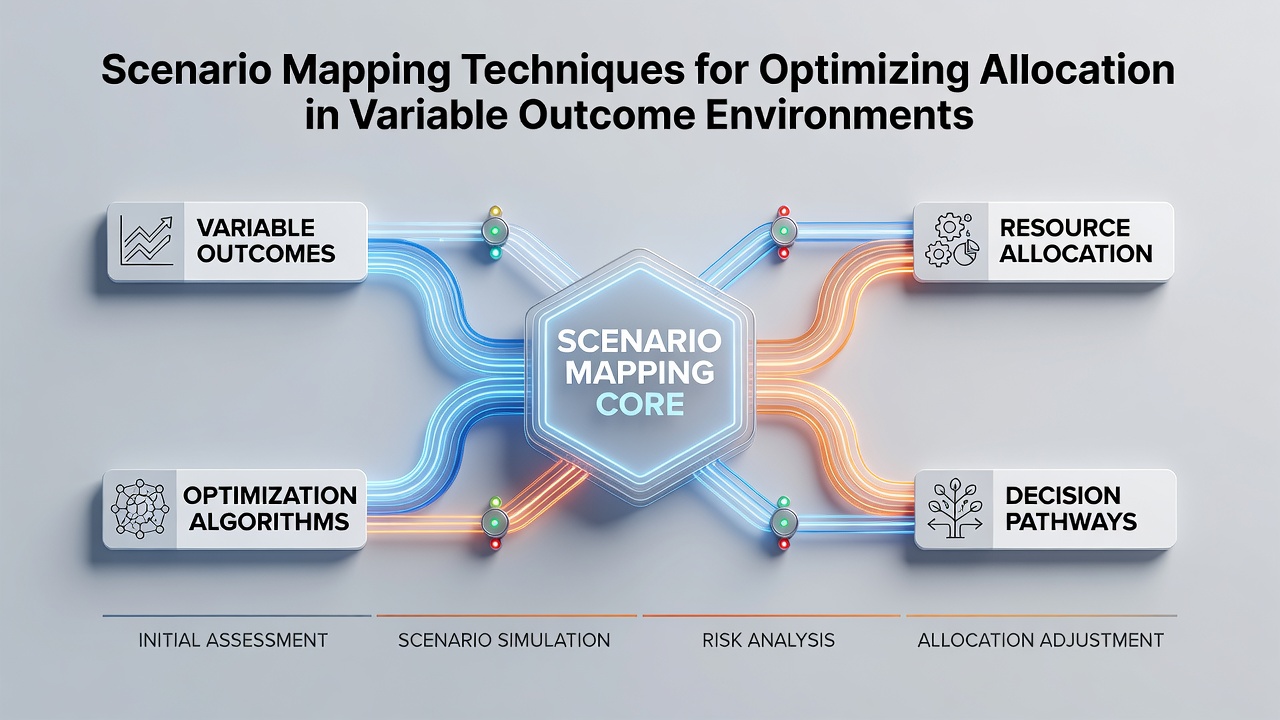
Scenario Mapping Techniques for Optimizing Allocation in Variable Outcome Environments
Scenario mapping techniques help organizations distribute resources when future conditions remain uncertain and multiple outcomes compete for attention, while data from various industries shows these methods reduce misallocation by identifying key drivers early in the planning cycle. Researchers at institutions across North America and Europe have documented how structured mapping breaks down complex variables into visual or tabular frameworks that reveal dependencies and priorities, and this approach connects directly to allocation decisions in sectors ranging from manufacturing to public infrastructure.
Core Components of Scenario Mapping
Experts define scenario mapping as the process of constructing multiple plausible futures based on critical uncertainties, then tracing how each path affects resource needs, and studies from the Australian Bureau of Statistics indicate that entities using these maps adjust budgets 18 percent more accurately than those relying on single-point forecasts. The technique starts with identifying driving forces such as regulatory shifts, technological adoption rates, and supply chain disruptions, after which teams plot these forces along axes of uncertainty and impact to generate distinct scenarios. Each scenario receives detailed narrative development that includes quantitative projections for costs, timelines, and required inputs, allowing planners to test allocation strategies against a range of conditions rather than one assumed baseline.
Observers note that effective maps incorporate both qualitative storylines and quantitative modeling, and this dual structure prevents over-reliance on historical data alone. One manufacturing firm in Canada applied the method to its 2025 capital expenditure plan and discovered that a high-inflation scenario required reallocating 12 percent of its equipment budget toward maintenance contracts instead of new purchases, and similar patterns appear in reports from the European Environment Agency on infrastructure projects facing climate variability.
Key Techniques and Their Application
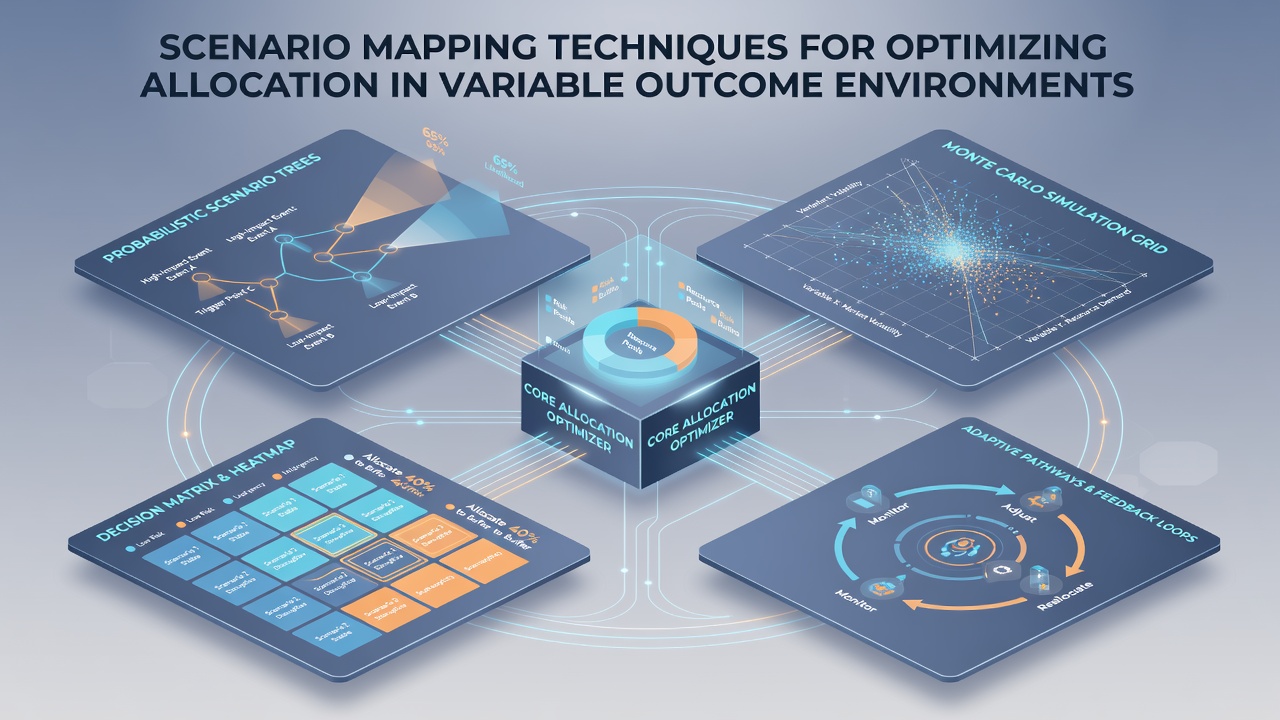
Several established techniques support scenario mapping, and each offers distinct advantages when allocation decisions involve variable outcomes. Cross-impact analysis examines how one event influences the probability of others, enabling teams to adjust resource pools dynamically as early signals emerge. Morphological analysis, by contrast, decomposes problems into independent parameters and recombines them into internally consistent configurations, which proves useful in research and development settings where technical choices interact unpredictably. Decision tree mapping adds branching probabilities and expected values at each node, giving finance teams a framework for staging investments across phases rather than committing full amounts upfront.
Data from the U.S. Department of Energy shows that agencies employing these combined techniques during renewable energy siting reduced permitting delays by an average of nine months between 2023 and 2025. Teams typically begin with workshops that surface assumptions, then move to software tools that simulate interactions across hundreds of variable combinations, and the resulting maps feed directly into phased funding models that release capital only when trigger conditions appear.
Integration with Allocation Processes
Scenario mapping integrates with allocation through iterative review cycles that update distributions as new information arrives, and this linkage becomes especially relevant in environments where outcomes diverge sharply. Organizations embed contingency thresholds within each scenario so that predefined budget shifts activate automatically when indicators cross certain lines, and this mechanism reduces the lag between signal detection and response. Public sector examples from Transport Canada demonstrate how mapping port expansion options against trade volume scenarios allowed officials to sequence dredging and terminal investments over a decade rather than committing simultaneously to all projects.
What's interesting is how the same maps also support communication with stakeholders, since visual representations make trade-offs explicit without requiring deep technical knowledge. Research published by the OECD highlights that governments using mapped scenarios for water resource planning achieved higher public acceptance rates for staged infrastructure spending compared with traditional master plans that presented single outcomes.
Implementation Considerations Across Sectors
Successful adoption requires cross-functional teams that include both subject matter experts and quantitative analysts, and regular updates to the underlying assumptions keep maps relevant as conditions evolve. In June 2026, several logistics companies in the Asia-Pacific region began publishing quarterly scenario updates tied to shipping lane variability, illustrating how mapping supports ongoing allocation tweaks rather than one-time exercises. Training programs that teach participants to distinguish between high-impact uncertainties and secondary variables further strengthen results, and case studies from university research centers show measurable improvements in forecast accuracy after such preparation.
Yet challenges remain when data quality varies across scenarios or when organizational incentives favor short-term certainty over long-term resilience. Entities that address these issues through transparent documentation and incentive realignment report more consistent use of the resulting allocation frameworks.
Conclusion
Scenario mapping techniques provide structured ways to anticipate variable outcomes and align resource allocation accordingly, and evidence from multiple regions confirms their role in improving decision quality under uncertainty. Organizations that embed these methods into planning cycles gain the ability to shift funds, personnel, and capital in response to emerging conditions while maintaining overall strategic direction. Continued refinement of mapping tools alongside advances in data integration promises further gains in both public and private sector applications.