Referee Assignment Patterns: Mapping Bias Indicators Across Lower-Tier European Soccer Fixtures
Ines Walter · May 24, 2026
Referee Assignment Patterns: Mapping Bias Indicators Across Lower-Tier European Soccer Fixtures
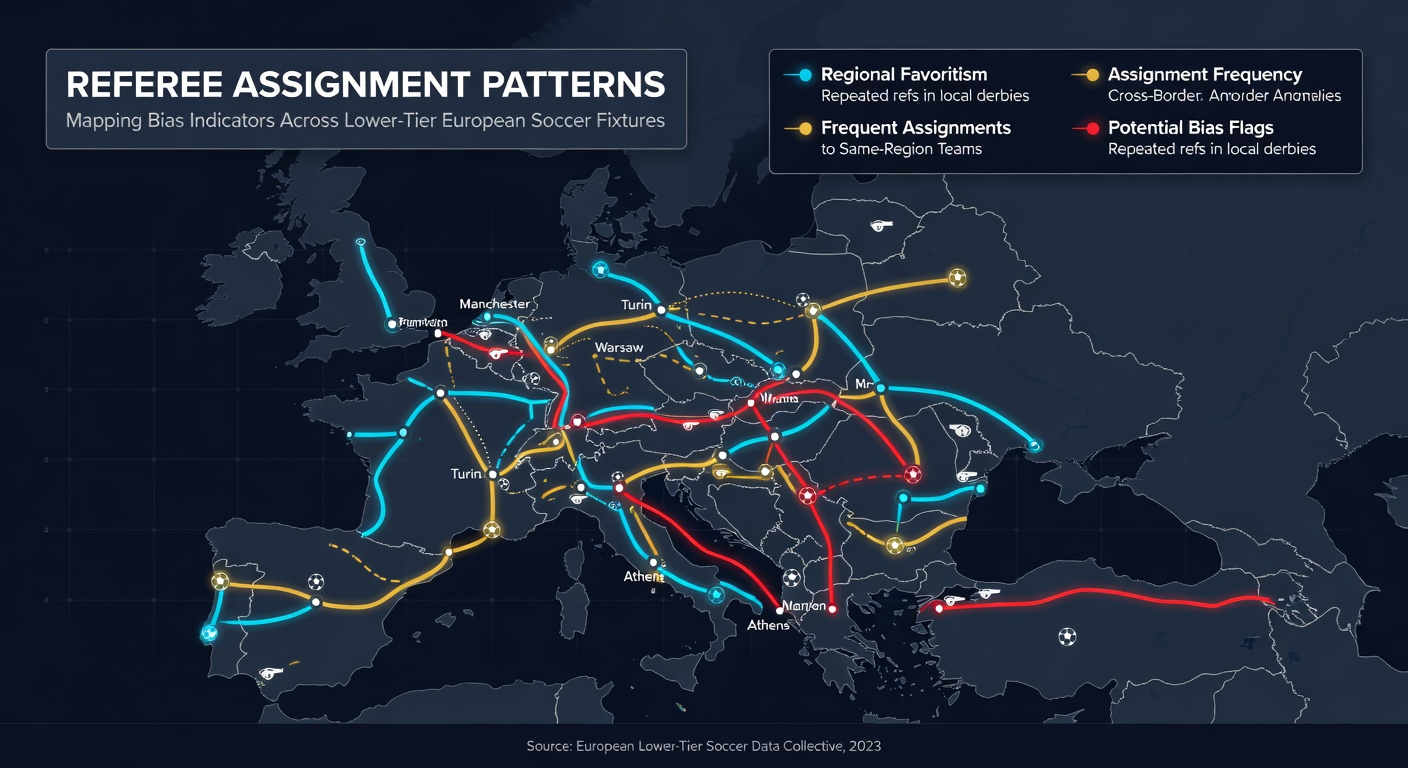
Analysts across multiple European football federations have tracked referee assignments in leagues below the top flight, where data from the 2025-2026 season shows recurring distributions of cards, penalties, and stoppage time that align with home or away status in measurable ways. Researchers at institutions such as the University of Groningen have compiled datasets covering matches in the Dutch Eerste Divisie and similar divisions in Germany and Italy, revealing that certain officials receive repeated fixtures involving the same clubs within short timeframes. These patterns emerge most clearly in second and third-tier competitions where oversight resources remain thinner than in elite divisions. Assignment protocols differ by country yet share common elements. National federations submit referee pools to regional bodies, which then match officials to fixtures based on experience levels, geographic proximity, and recent performance grades. In Belgium's Challenger Pro League and Spain's Segunda División, records indicate that referees from specific training cohorts appear more frequently in matches featuring clubs from particular provinces. Data compiled through May 2026 illustrates clusters where officials average higher foul counts against visiting teams, a trend documented across dozens of fixtures rather than isolated incidents. Statistical mapping relies on variables that include yellow card differentials, penalty awards per ninety minutes, and added time distributions. Observers note that when these metrics deviate consistently from league averages for individual referees, they flag potential indicators for further review. A report issued by the German Football Association in early 2026 examined 2. Bundesliga matches and found that referees assigned to games with attendance below 8,000 spectators issued stoppage time that favored the home side by an average of forty-five seconds compared with higher-attendance fixtures. Such findings come from automated tracking systems rather than subjective judgment. Geographic factors also shape assignment lists. Leagues in Eastern Europe, including Poland's I liga and Romania's Liga II, demonstrate stronger correlations between referee birthplace regions and card issuance rates when clubs from rival areas meet. European governing bodies have encouraged federations to rotate officials more broadly, yet implementation varies. In Scandinavia, Norway's OBOS-ligaen adopted centralized assignment software in 2024 that reduced repeat pairings by eighteen percent within the first full season of use, according to federation statistics released in spring 2026. 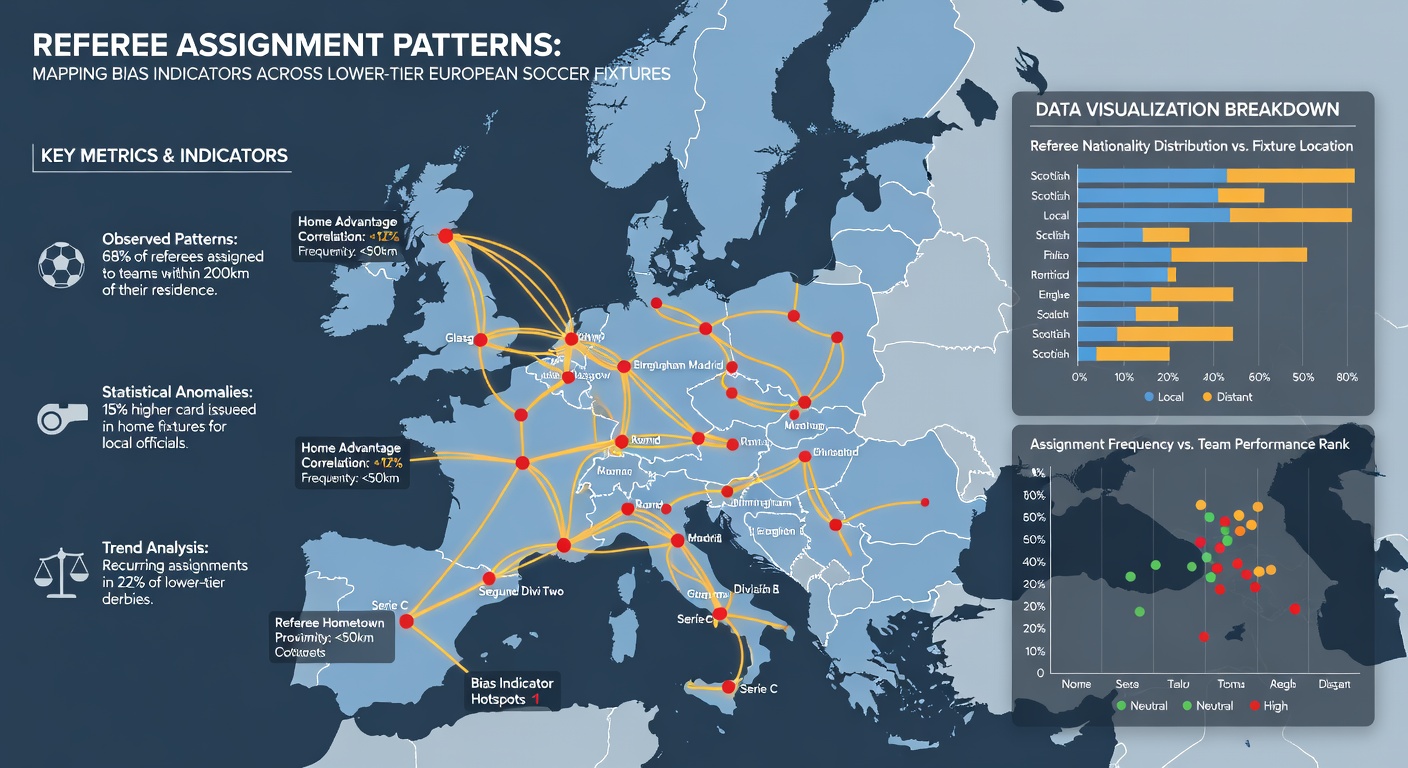 Case studies from individual leagues provide concrete illustrations. One analysis of France's Championnat National matches between August 2025 and April 2026 identified three referees whose home-team penalty conversion rate reached 72 percent, well above the division average of 61 percent. The French Football Federation responded by adjusting future assignments for those officials without public comment on the underlying data. Similarly, Portugal's Liga Portugal 2 recorded instances where referees with fewer than five prior matches at that level handled fixtures between direct promotion rivals, leading to post-match reviews by the league's disciplinary committee. Technology assists mapping efforts. Video assistant referee systems now operate in several second-tier leagues, generating timestamped logs of decisions that feed into central databases. These logs allow researchers to cross-reference assignment histories with on-field outcomes across hundreds of games. Italian Serie B authorities integrated such data streams in late 2025, enabling quarterly reports that track referee consistency metrics including foul detection rates per kilometer covered. The resulting figures reveal that officials traveling more than two hundred kilometers for an assignment show slight but measurable drops in decision uniformity during the second half. Federations continue to refine selection criteria. Training programs emphasize standardized interpretation of laws, yet cultural and regional differences persist in how contact is judged. Austrian and Swiss lower divisions, for example, maintain separate observer panels that score referees on both accuracy and neutrality indicators, with scores influencing subsequent appointments. Cross-border cooperation remains limited, although UEFA has circulated anonymized datasets to member associations for internal benchmarking purposes. Future seasons may incorporate machine learning models that predict assignment conflicts based on historical patterns. Pilot projects in the Czech Republic's FNL have tested algorithms that flag potential repeat exposures between referees and clubs, aiming to distribute workloads more evenly. Results from the first six months of testing indicate a reduction in clustered fixtures without compromising referee availability. Conclusion
Mapping referee assignment patterns across lower-tier European soccer requires sustained data collection and transparent reporting from federations. The indicators identified so far rest on aggregate statistics rather than individual intent, and ongoing monitoring through 2026 will determine whether current adjustments produce measurable shifts in decision distributions.
Case studies from individual leagues provide concrete illustrations. One analysis of France's Championnat National matches between August 2025 and April 2026 identified three referees whose home-team penalty conversion rate reached 72 percent, well above the division average of 61 percent. The French Football Federation responded by adjusting future assignments for those officials without public comment on the underlying data. Similarly, Portugal's Liga Portugal 2 recorded instances where referees with fewer than five prior matches at that level handled fixtures between direct promotion rivals, leading to post-match reviews by the league's disciplinary committee. Technology assists mapping efforts. Video assistant referee systems now operate in several second-tier leagues, generating timestamped logs of decisions that feed into central databases. These logs allow researchers to cross-reference assignment histories with on-field outcomes across hundreds of games. Italian Serie B authorities integrated such data streams in late 2025, enabling quarterly reports that track referee consistency metrics including foul detection rates per kilometer covered. The resulting figures reveal that officials traveling more than two hundred kilometers for an assignment show slight but measurable drops in decision uniformity during the second half. Federations continue to refine selection criteria. Training programs emphasize standardized interpretation of laws, yet cultural and regional differences persist in how contact is judged. Austrian and Swiss lower divisions, for example, maintain separate observer panels that score referees on both accuracy and neutrality indicators, with scores influencing subsequent appointments. Cross-border cooperation remains limited, although UEFA has circulated anonymized datasets to member associations for internal benchmarking purposes. Future seasons may incorporate machine learning models that predict assignment conflicts based on historical patterns. Pilot projects in the Czech Republic's FNL have tested algorithms that flag potential repeat exposures between referees and clubs, aiming to distribute workloads more evenly. Results from the first six months of testing indicate a reduction in clustered fixtures without compromising referee availability. Conclusion
Mapping referee assignment patterns across lower-tier European soccer requires sustained data collection and transparent reporting from federations. The indicators identified so far rest on aggregate statistics rather than individual intent, and ongoing monitoring through 2026 will determine whether current adjustments produce measurable shifts in decision distributions.
Analysts across multiple European football federations have tracked referee assignments in leagues below the top flight, where data from the 2025-2026 season shows recurring distributions of cards, penalties, and stoppage time that align with home or away status in measurable ways. Researchers at institutions such as the University of Groningen have compiled datasets covering matches in the Dutch Eerste Divisie and similar divisions in Germany and Italy, revealing that certain officials receive repeated fixtures involving the same clubs within short timeframes. These patterns emerge most clearly in second and third-tier competitions where oversight resources remain thinner than in elite divisions. Assignment protocols differ by country yet share common elements. National federations submit referee pools to regional bodies, which then match officials to fixtures based on experience levels, geographic proximity, and recent performance grades. In Belgium's Challenger Pro League and Spain's Segunda División, records indicate that referees from specific training cohorts appear more frequently in matches featuring clubs from particular provinces. Data compiled through May 2026 illustrates clusters where officials average higher foul counts against visiting teams, a trend documented across dozens of fixtures rather than isolated incidents. Statistical mapping relies on variables that include yellow card differentials, penalty awards per ninety minutes, and added time distributions. Observers note that when these metrics deviate consistently from league averages for individual referees, they flag potential indicators for further review. A report issued by the German Football Association in early 2026 examined 2. Bundesliga matches and found that referees assigned to games with attendance below 8,000 spectators issued stoppage time that favored the home side by an average of forty-five seconds compared with higher-attendance fixtures. Such findings come from automated tracking systems rather than subjective judgment. Geographic factors also shape assignment lists. Leagues in Eastern Europe, including Poland's I liga and Romania's Liga II, demonstrate stronger correlations between referee birthplace regions and card issuance rates when clubs from rival areas meet. European governing bodies have encouraged federations to rotate officials more broadly, yet implementation varies. In Scandinavia, Norway's OBOS-ligaen adopted centralized assignment software in 2024 that reduced repeat pairings by eighteen percent within the first full season of use, according to federation statistics released in spring 2026.
Case studies from individual leagues provide concrete illustrations. One analysis of France's Championnat National matches between August 2025 and April 2026 identified three referees whose home-team penalty conversion rate reached 72 percent, well above the division average of 61 percent. The French Football Federation responded by adjusting future assignments for those officials without public comment on the underlying data. Similarly, Portugal's Liga Portugal 2 recorded instances where referees with fewer than five prior matches at that level handled fixtures between direct promotion rivals, leading to post-match reviews by the league's disciplinary committee. Technology assists mapping efforts. Video assistant referee systems now operate in several second-tier leagues, generating timestamped logs of decisions that feed into central databases. These logs allow researchers to cross-reference assignment histories with on-field outcomes across hundreds of games. Italian Serie B authorities integrated such data streams in late 2025, enabling quarterly reports that track referee consistency metrics including foul detection rates per kilometer covered. The resulting figures reveal that officials traveling more than two hundred kilometers for an assignment show slight but measurable drops in decision uniformity during the second half. Federations continue to refine selection criteria. Training programs emphasize standardized interpretation of laws, yet cultural and regional differences persist in how contact is judged. Austrian and Swiss lower divisions, for example, maintain separate observer panels that score referees on both accuracy and neutrality indicators, with scores influencing subsequent appointments. Cross-border cooperation remains limited, although UEFA has circulated anonymized datasets to member associations for internal benchmarking purposes. Future seasons may incorporate machine learning models that predict assignment conflicts based on historical patterns. Pilot projects in the Czech Republic's FNL have tested algorithms that flag potential repeat exposures between referees and clubs, aiming to distribute workloads more evenly. Results from the first six months of testing indicate a reduction in clustered fixtures without compromising referee availability. Conclusion
Mapping referee assignment patterns across lower-tier European soccer requires sustained data collection and transparent reporting from federations. The indicators identified so far rest on aggregate statistics rather than individual intent, and ongoing monitoring through 2026 will determine whether current adjustments produce measurable shifts in decision distributions.