Correlation Dynamics Across Simultaneous Basketball Contests and Parlay Refinement Techniques
Ines Walter · Jul 19, 2026

Correlation Dynamics Across Simultaneous Basketball Contests and Parlay Refinement Techniques
Concurrent basketball matches create measurable statistical overlaps that influence parlay outcomes, and analysts track these patterns through historical datasets from major leagues. Data collected across multiple NBA seasons shows that games played on the same night often share variables such as travel fatigue, referee crews, and league-wide scoring trends, which alter the independence assumptions built into standard accumulator pricing.
Defining Correlation in Live Game Environments
Positive correlation arises when external factors push results in the same direction, for instance when back-to-back scheduling reduces scoring in several contests simultaneously. Negative correlation appears when one outcome offsets another, such as when high-paced Eastern Conference games coincide with slower Western Conference matchups on the same evening. Researchers at institutions including the University of Nevada's International Gaming Institute have quantified these effects using regression models that isolate shared variance across 2018-2025 regular-season data.
Measuring Overlaps Through Statistical Frameworks
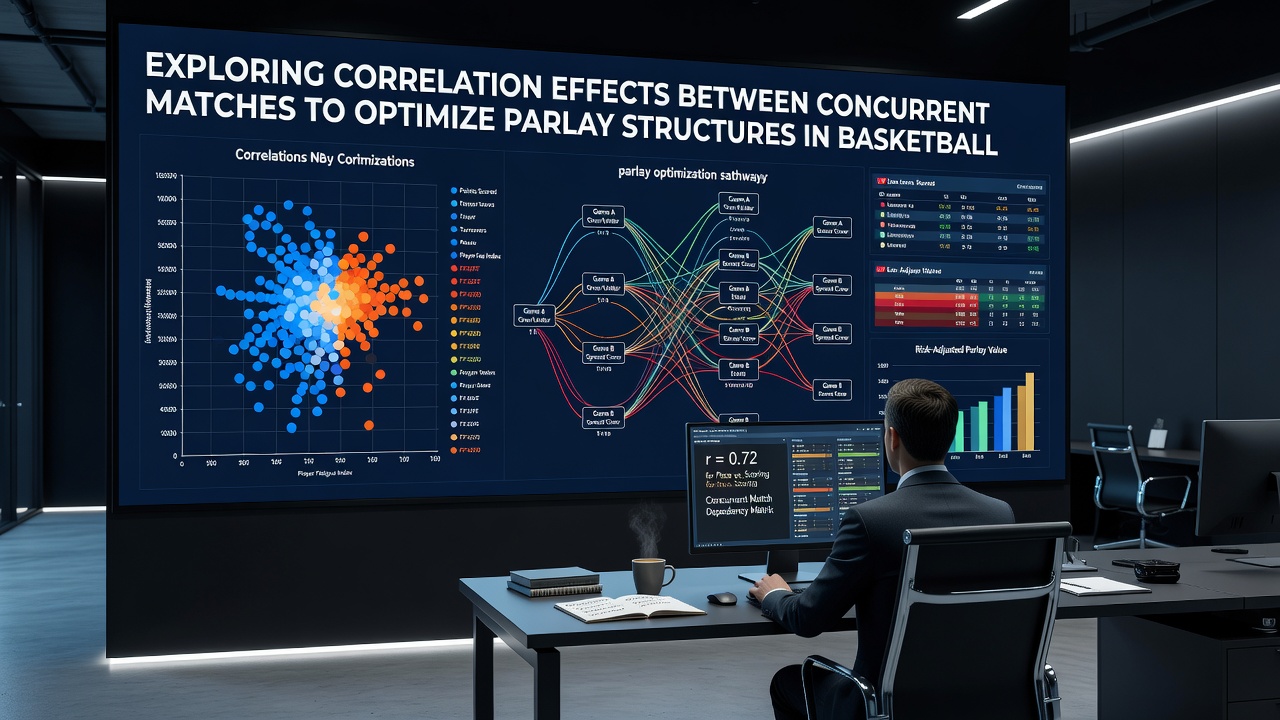
Advanced metrics combine box-score aggregates with real-time pace indicators to calculate covariance between simultaneous games. Models that incorporate player-availability updates, arena-specific shooting percentages, and rest differentials produce correlation coefficients ranging from 0.15 to 0.42 for same-conference slates. Observers note that these values shift during condensed schedules, particularly in January and March when teams face compressed travel calendars.
Application to Parlay Construction
Parlay builders adjust stake allocation once correlation matrices flag elevated dependence between selected legs. When two games display a coefficient above 0.30, the joint probability deviates from the product of individual probabilities, prompting analysts to either reduce exposure or seek offsetting selections from less connected contests. Simulation outputs from 2025-2026 season data indicate that portfolios incorporating decorrelated legs maintain lower drawdown frequencies compared with randomly assembled multis.
External factors such as national television windows also introduce systematic effects, because nationally televised games tend to feature different officiating emphasis and higher possession counts. July 2026 offseason reports from Canadian provincial gaming authorities highlighted similar patterns in summer league environments, where limited rosters amplify cross-game dependencies.
Practical Implementation Steps
Teams begin by sourcing play-by-play logs and injury reports released three hours before tip-off. They then feed these inputs into covariance calculators that output adjusted odds for two-leg, three-leg, and four-leg combinations. One documented workflow used by professional syndicates involves running 10,000 Monte Carlo iterations per slate while constraining selections to games whose correlation remains below a preset threshold of 0.25. Results from such constrained simulations show reduced variance in realized returns across full seasons.
Regional Data Sources and Validation
Validation draws from multiple jurisdictions. Australian wagering operators publish aggregated parlay payout ratios that align with correlation-adjusted forecasts, while European sports-data providers supply granular event timing that refines live covariance estimates. Cross-checking these independent feeds reduces model drift and confirms that correlation effects persist across different time zones and arena conditions.
Conclusion
Correlation mapping between concurrent basketball matches supplies a quantifiable edge for parlay structuring when models integrate travel, rest, and officiating variables. Continued refinement of these statistical layers, supported by expanding datasets through 2026, enables systematic adjustment of accumulator compositions without reliance on subjective adjustments.